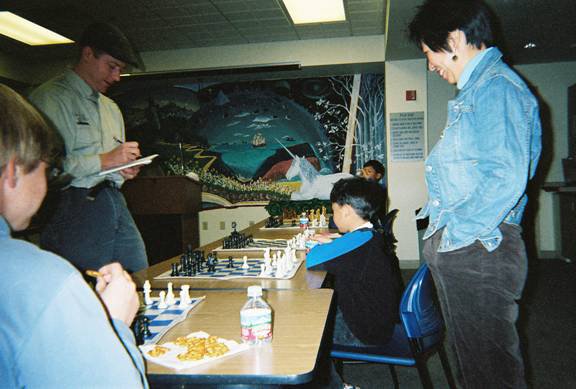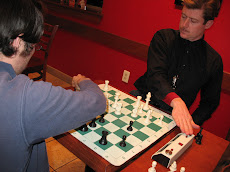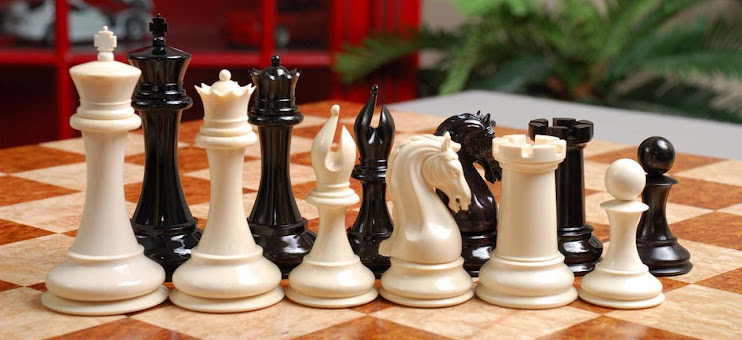
Here is my latest chess lesson for our Scholastic Chess Players - it is all about finding our best move or moves, looking out for our opponent's best moves and always aiming for checkmate! It is about the power of open lines and the "rule of three or more" - we need a combination of three or more pieces or pawns attacking an enemy King's position for our attack to be successful.
I hope everyone enjoys this lesson. - Chess Coach Sean Tobin.
----------------------------------------------------------
BLACK : COACH Sean
BLACK : COACH Sean

Andre Cardoso*
This is from a recent correspondence game that I played online. This game had a happy ending - even if my opening play was a little bit off course. I managed to build this nice position by aiming my pieces at my opponent's King. Having the two Bishops versus his* Knights were a big help in allowing me to win this game!
* I could have been playing a cactus for all I know... or a man, woman or computer. I probably wasn't playing a dog though - of that I am sure! This was an online game and you never can just tell who you are really playing!
The above position is after the move pair 27. Kg3 Ref8 ... and coach Sean has a plan in this position!
I built a really good position by aiming both of my Bishops TOWARDS/AT my opponent's King and by using my open f-file. Which conveniently enough leads to my opponent's King!
Remember to check your "lines" or "lasers" - this way you can "see" what your Queens, Bishops and Rooks are really looking at. Remember that each of these pieces can fork other pieces or pin one piece against another - as well as delivering skewers too!
While building this position - or debating it with my opponent - I had to watch out for his Knight's. Remember the Octopus is AWESOME at delivering forks! I also had to check his laser beam or line pieces as well - and to look at every square along the "line of their sight" so that I could watch out for tricks!

28. Ne7 +
Enjoy the lesson and feel free to show me your checkmate solutions!Did I miss that check? Maybe I would have - if I had not looked at EVERY SQUARE that my opponent's pieces COULD HAVE LANDED ON. What is important in this position is that I have found a forced win - open lines and control over the squares around my opponent's King.
My opponent has just given me a check... but what square should I move my King to? Take your time and think about the next move and see if you can find the move that I played here in this position.
To make sure I have a winning line of play - a forcing line of play - I had to look out for all of my opponent's tricks. And that meant checking every one of his/her/it's/the cactus's moves - looking at every square that one of my opponent's pieces could land on and then imagining what squares that piece would be looking at once it got there. This took time of course! That is why we need to build our positions slowly - like cooks cooking up something good to eat. Like let us say Japanese Curry! Something yummy for us and not our opponents! What we end up making we hope will give our opponent a belly full of chess ache!

Ok so after my opponent played the move 28. Ne7 + I moved my King UP to the g7 square. Before I made that move I made sure that my Bishop was covering the d7 square - the one that WAS on c8 and that the pawn on c7 was covering the d6 square. This is important actually... and now it is my move after my opponent grabbed my Bishop.
See how awesome my Rooks are doubled up on the f-file! Those pawns on e4 and g5 are helping to control some squares around my opponent's King. So I have the "RULE OF THREE" going on in this position - that is to say I have a combination of three or more pieces and pawns near my opponent's King. The two Rooks control the f-file - while the Rook on f2 prevents my opponent's King from running backwards. Herr Konig (That is German for King.) has been pulled out onto part of the dance floor so things are not looking good for my opponent's King. Two Rooks and two pawns are on the attack - can I add a fifth attacker as well? Perhaps a nice quiet move is called for here - one that allows me to control an important square around my opponent's King.

My opponent has just given me a check... but what square should I move my King to? Take your time and think about the next move and see if you can find the move that I played here in this position.
To make sure I have a winning line of play - a forcing line of play - I had to look out for all of my opponent's tricks. And that meant checking every one of his/her/it's/the cactus's moves - looking at every square that one of my opponent's pieces could land on and then imagining what squares that piece would be looking at once it got there. This took time of course! That is why we need to build our positions slowly - like cooks cooking up something good to eat. Like let us say Japanese Curry! Something yummy for us and not our opponents! What we end up making we hope will give our opponent a belly full of chess ache!
28. Ne7 + Kg7 and 29. Nxc8
Should I just automatically recapture here?
Should I just automatically recapture here?
Ok so after my opponent played the move 28. Ne7 + I moved my King UP to the g7 square. Before I made that move I made sure that my Bishop was covering the d7 square - the one that WAS on c8 and that the pawn on c7 was covering the d6 square. This is important actually... and now it is my move after my opponent grabbed my Bishop.
See how awesome my Rooks are doubled up on the f-file! Those pawns on e4 and g5 are helping to control some squares around my opponent's King. So I have the "RULE OF THREE" going on in this position - that is to say I have a combination of three or more pieces and pawns near my opponent's King. The two Rooks control the f-file - while the Rook on f2 prevents my opponent's King from running backwards. Herr Konig (That is German for King.) has been pulled out onto part of the dance floor so things are not looking good for my opponent's King. Two Rooks and two pawns are on the attack - can I add a fifth attacker as well? Perhaps a nice quiet move is called for here - one that allows me to control an important square around my opponent's King.
Ah - the move 28. ...h5 does the trick!
The mating net is pulled tighter and tighter and now there is no escape for the White Monarch! Makes me glad that I am playing the Black pieces here!
Please notice that if my opponent plays the move 29. Rd7 that I can now play 29. ...Kh6! and he will be unable to check me with either the Knight or the Rook. Well ok, he could check me with the Rook but then I would just eat it with my pawn on c7! Yummylicious! Of course I HAD TO KNOW THIS BEFORE I PLAYED MY PREVIOUS MOVES! If my opponent could check me and save his Knight and prevent my checkmate then I would just lose this game. Big time.
My opponent actually resigned in this position! Was he right to? Can you show at least three different checkmates from the final position. Are there any moves that he can play to give his King an escape square?
Please notice that if my opponent plays the move 29. Rd7 that I can now play 29. ...Kh6! and he will be unable to check me with either the Knight or the Rook. Well ok, he could check me with the Rook but then I would just eat it with my pawn on c7! Yummylicious! Of course I HAD TO KNOW THIS BEFORE I PLAYED MY PREVIOUS MOVES! If my opponent could check me and save his Knight and prevent my checkmate then I would just lose this game. Big time.
My opponent actually resigned in this position! Was he right to? Can you show at least three different checkmates from the final position. Are there any moves that he can play to give his King an escape square?
- Chess Coach Sean Tobin.